Fabric Scanning & Material Pipeline
2023
Digitising real-world fabric swatches into scalable, production-ready materials.
- Photometric stereo + RTI workflow
- High-volume material creation
- Designed for real-time 4K rendering
The Problem
From my experience, one of the biggest challenges in this space is processing at scale. Most clients operate with large product catalogues, where each asset is tied to multiple variable model formats, reference material, and data requirements making time and cost difficult to predict.
For one client, we were tasked with recreating a full library of ~300 unique fabric materials (~400 including colour variations) from physical swatches within a 1–2 week timeframe.
At this scale, traditional approaches quickly break down. Maintaining visual consistency, colour accuracy, and flexibility for iteration becomes increasingly difficult, especially when materials need to remain editable throughout the production pipeline.
The Solution
A. Capture System
To address this, I developed a workflow built around two core stages.
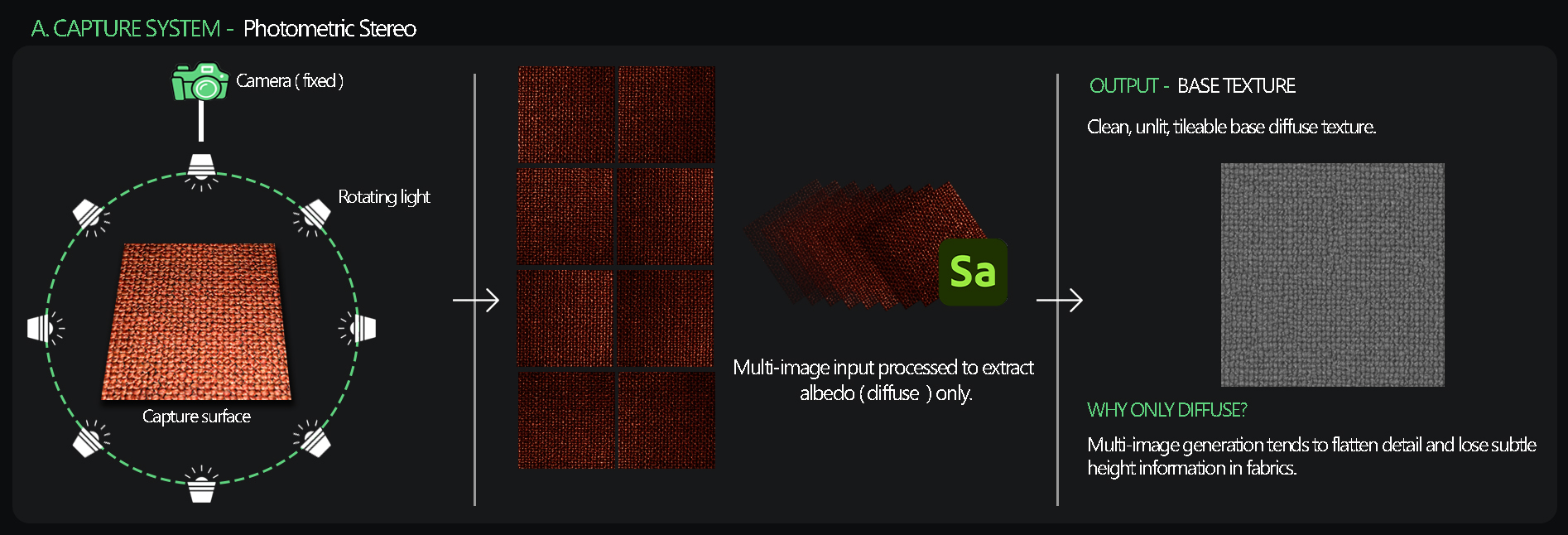
The capture setup consists of a fixed camera, a controlled surface, and a single light source rotated across specific angles. Each sample is photographed from 8 lighting directions, capturing a range of surface responses from a consistent viewpoint.
These images are processed in Substance 3D Sampler to generate a clean, unlit, tileable base texture. At this stage, the goal is strictly to extract a reliable diffuse/albedo base. While multi-image inputs can be used to generate additional maps, this often results in flattened detail and loss of surface depth, particularly with fabric materials.
Instead, the workflow intentionally avoids generating normals or height here, preserving as much usable information as possible for later stages.
B. Processing & Material Creation
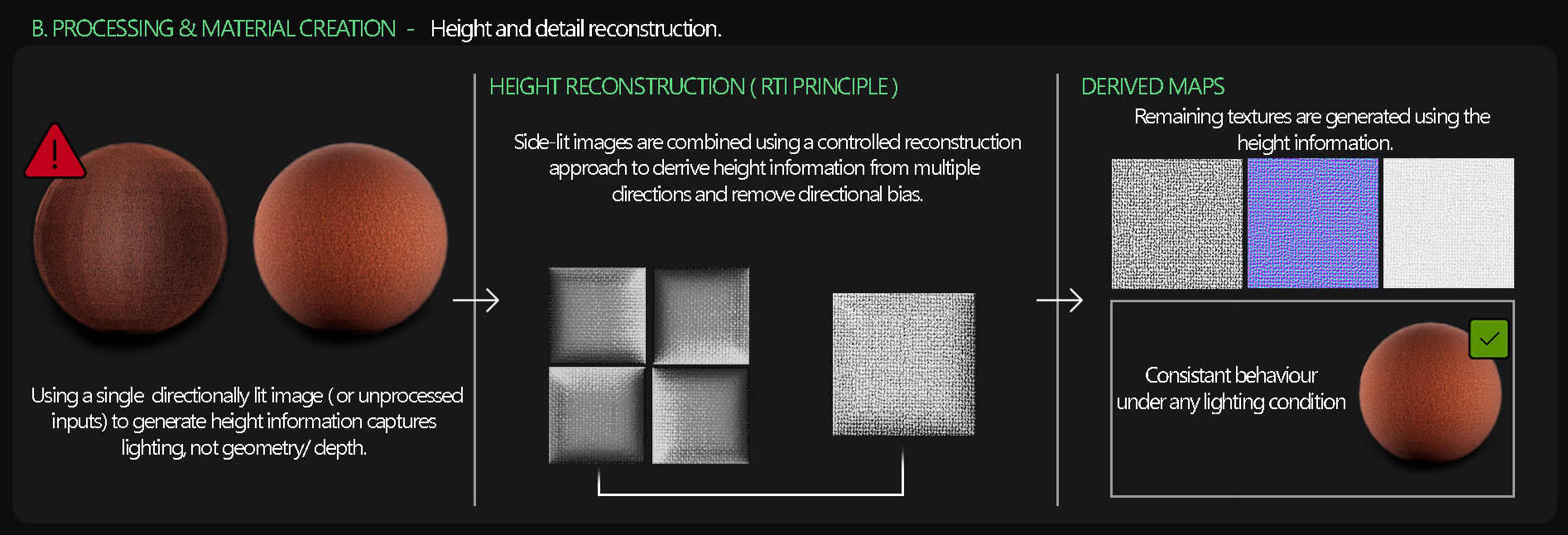
Capturing accurate surface depth for fabrics introduces a common issue: using images that contain directional lighting information (shadows/highlights) directly for height generation leads to incorrect material behaviour. This typically results in materials that only respond correctly when the lighting direction matches the original capture — something that breaks immediately in real-time or dynamic lighting environments.
To avoid this, the workflow isolates specific inputs from the original capture set: only the side-lit images are used (excluding corner-lit captures), as these provide more consistent and converging surface information. These inputs are then processed through a controlled reconstruction approach, allowing surface depth to be derived from multiple lighting directions while removing any dependency on a single light source.
The result is a clean, neutral height map, based on the same principles used in reflectance transformation imaging, where lighting variation is used to infer surface structure rather than being baked into it.
The Outcome
This workflow transforms what is typically a slow, inconsistent process into a predictable and scalable system for material creation.
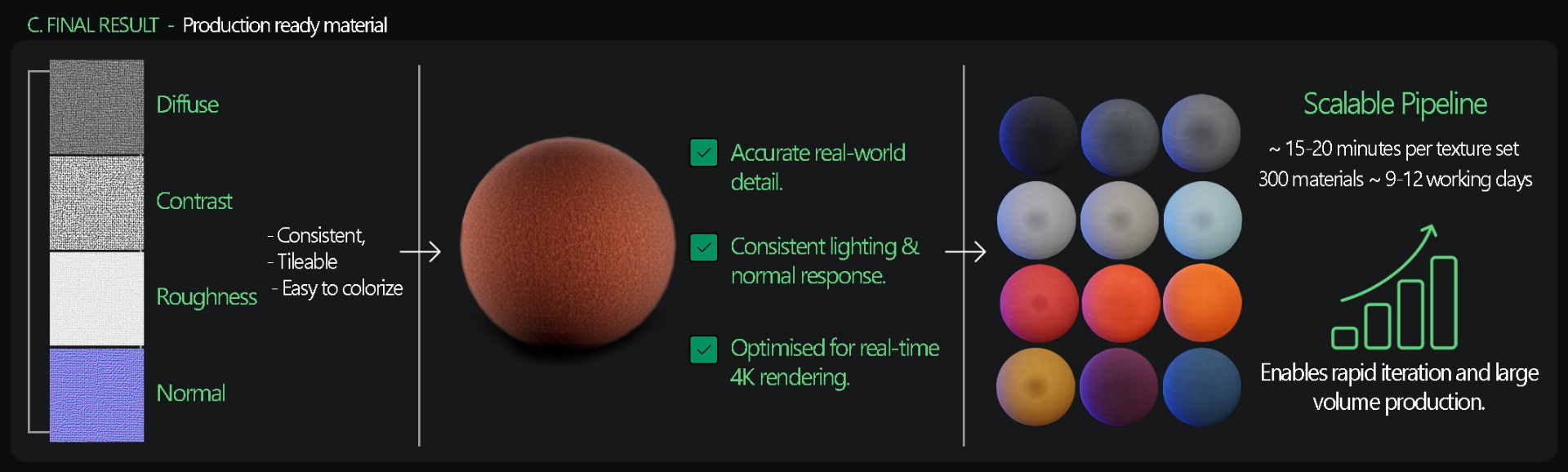
By standardising both capture and processing, the pipeline removes much of the manual variability, allowing large volumes of materials to be produced without compromising visual fidelity. At scale, this enables the creation of full material catalogues within tight deadlines — while maintaining the level of quality required for real-time 4K rendering.
The workflow can also be extended with tools such as Nix Color Sensor to further improve colour accuracy without adding complexity to the process.
- ~15–20 minutes per material from capture to final texture set
- Consistent outputs across large material libraries
- Materials remain fully editable and adaptable for iteration
Software & Tools