2026
FXstudio — Realtime Production Tool
A real-time, data-driven Unreal Engine pipeline replacing offline render farms with continuous 4K 360° output.
- Data-driven pipeline
- 4K 360° output in seconds
- 25,000+ renders delivered
The Problem
When working with high-volume image and animation pipelines, rendering quickly becomes a major constraint in both time and cost. This is especially true for smaller studios, where reliance on render farms introduces ongoing infrastructure and usage costs that are difficult to justify without consistent demand.
To ground this in a real production scenario, one of the projects I worked on over a 1.5-year period required the delivery of approximately 25,000 product animations.
While the scene setup itself was relatively simple, the required visual fidelity introduced significant overhead, utilising 4K textures, displacement, and layered material adjustments.
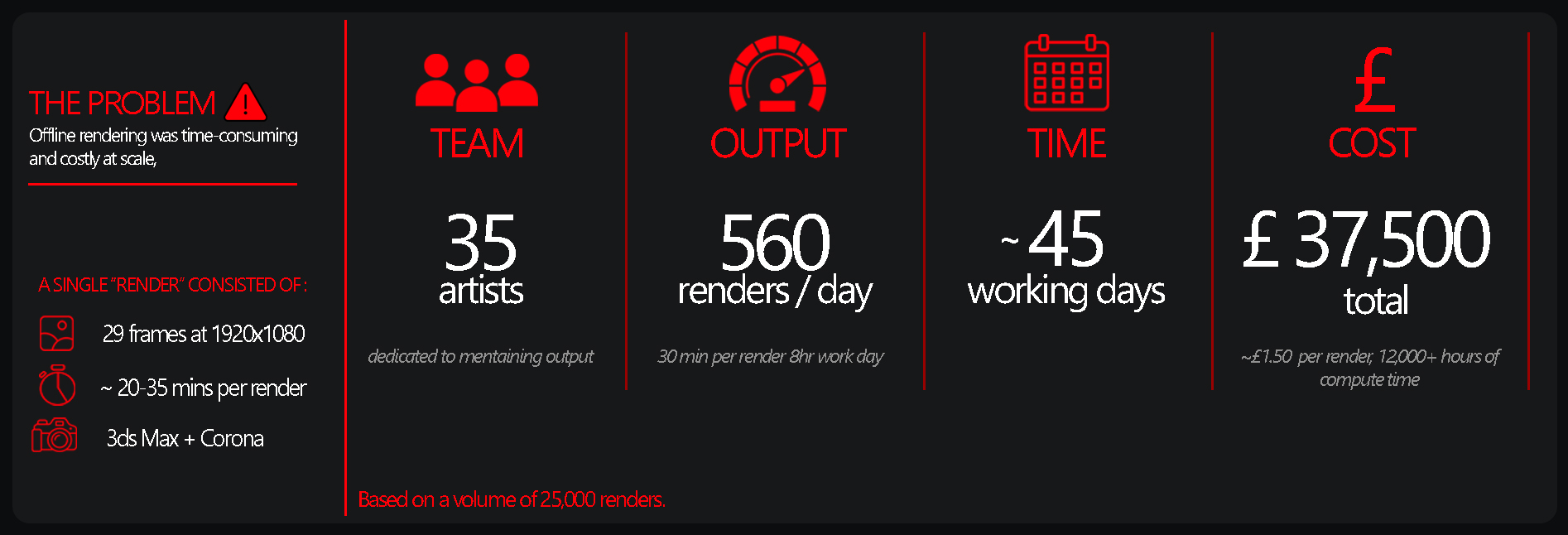
At an average of 30 minutes per render (~£1.50 per output), a team of 35 artists could produce approximately 560 renders per day, requiring ~45 working days to complete a batch of 25,000 renders.
While manageable at this scale, the pipeline had very little flexibility. Any increase in output volume or visual quality introduced a direct and often exponential impact on both time and cost.
This became a critical limitation when project requirements evolved to include 4K output, while maintaining the same delivery timelines and budget constraints.
The Solution
At this stage, continuing to optimise the existing offline rendering pipeline was no longer a viable path. While incremental improvements could reduce render times, they did not address the core limitation rendering remained inherently time- and cost-bound.
In parallel, I had already been exploring real-time workflows in Unreal Engine, initially focused on material editing and look development. This early work highlighted the potential for real-time rendering to extend beyond preview and into production.
As project requirements evolved to include 4K output, the limitations of the existing pipeline became more pronounced. Rather than continuing to optimise a system that fundamentally did not scale, the decision was made to formally investigate a real-time alternative.
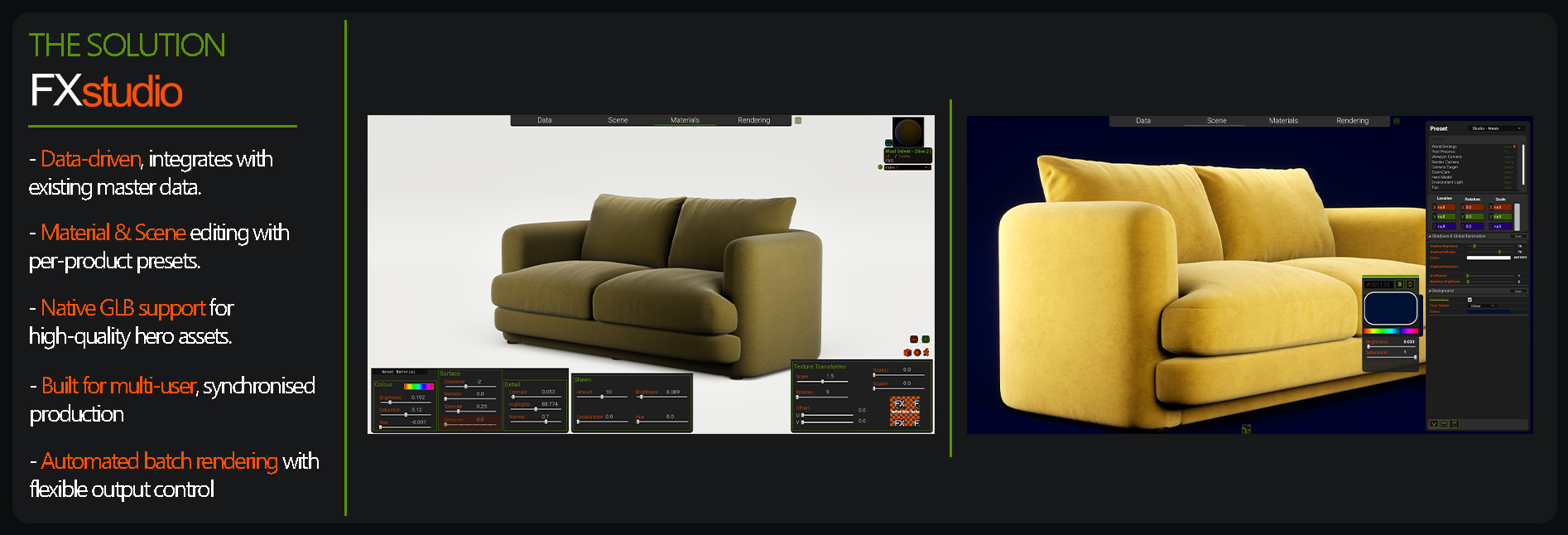
A one-month proof of concept was developed to validate whether a data-driven, real-time workflow could meet both the visual and production requirements. Following internal review and approval, this evolved into a full system designed to handle high-volume rendering in a predictable and scalable way.
This marked a shift in approach:
The focus was not to replicate offline rendering feature-for-feature, but to achieve a level of visual quality that was fit for purpose, while enabling significant gains in speed, cost, and scalability.
The Outcome
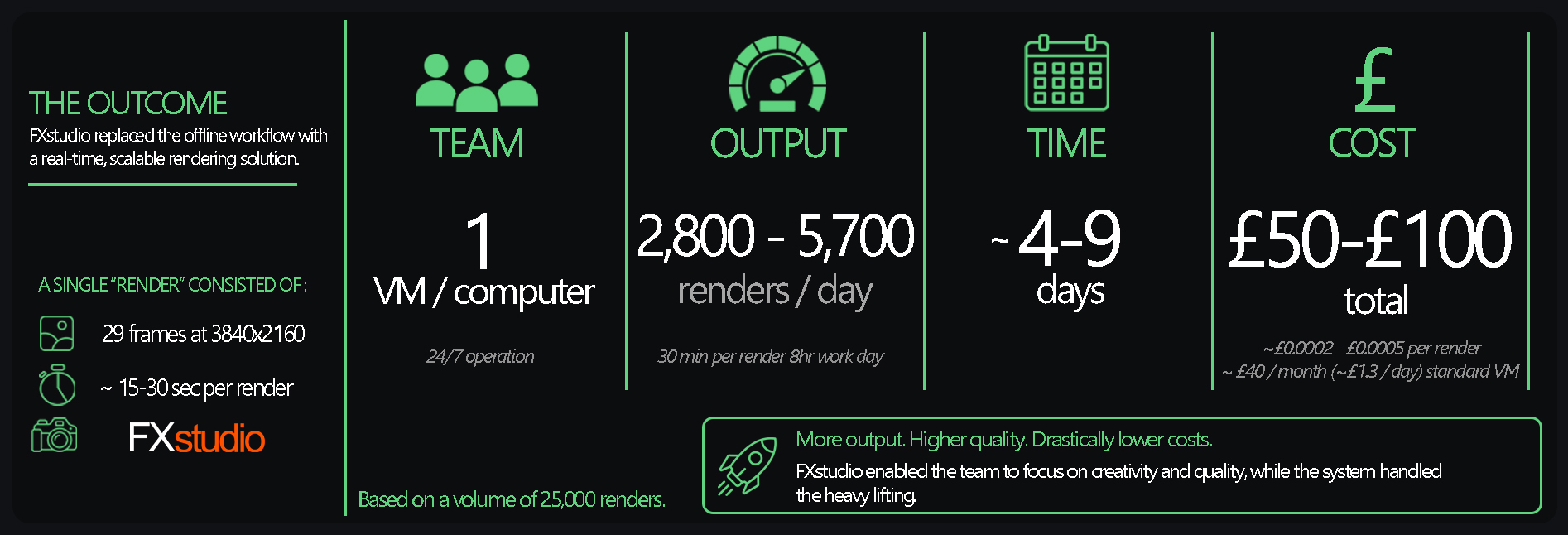
The system replaced a time-intensive, team-driven rendering workflow with a scalable, real-time pipeline.
Compared to the previous workflow, which required a dedicated team to maintain production throughout, running FXS on a standard virtual machine setup (~£40/month) enabled continuous 24-hour output with a negligible per-render cost (~£0.0002–£0.0005).
These comparisons are based on internal projections of outsourced rendering costs. The transition to FXs was made prior to any outsourcing, and the system was implemented to support existing production rather than replace it.
Role & Ownership
As FXS moved from proof of concept into production, my role expanded into ownership of both the technical pipeline and the final output quality.
- Ongoing development and maintenance of the tool
- Ensuring visual consistency and quality across all outputs
- Managing iterations based on client feedback
- Supporting production teams at scale